How Australian Students Balance Pro-Gaming Aspirations with University Finals
The “grind” is a term well-understood by two very different groups in Australia: competitive gamers climbing the ranks in League of Legends or Valorant, and university students hunkered down in the Fisher Library or the State Library of Victoria during finals week. In 2026, these two worlds are colliding more than ever.
As the Australian esports market continues its trajectory toward a projected value of USD 246 million by 2032, the professionalisation of gaming has turned a hobby into a high-stakes career path. However, for the thousands of domestic students currently filling the university places allocated for the 2026 academic year, the pressure to maintain a high GPA while chasing a pro-contract is immense. Balancing these dual identities requires more than just “good vibes”—it requires a senior strategist’s approach to time management and resource allocation.
The High Stakes of the Australian Academic Calendar
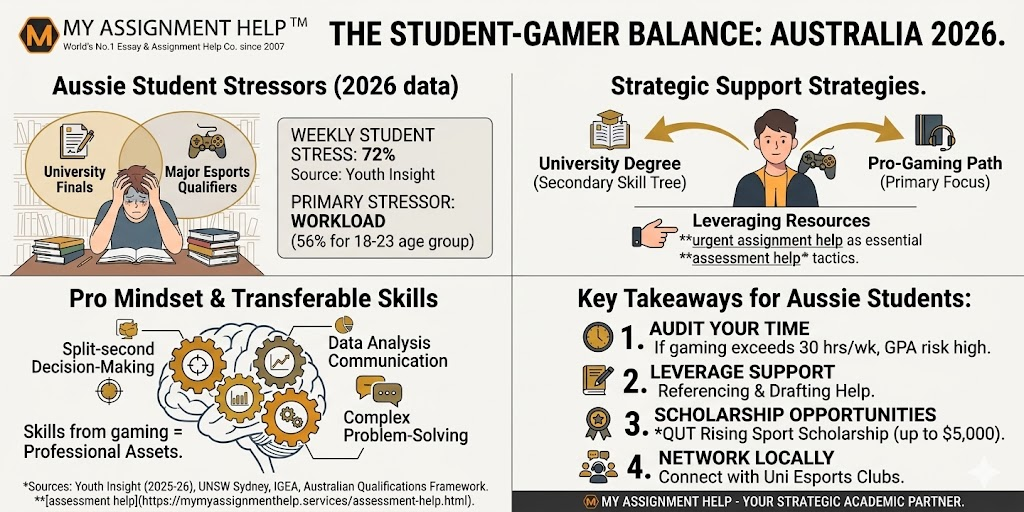
For students at institutions like USYD, Monash, or UQ, the semester’s end brings a crushing workload. Data from Youth Insight (updated for 2026) reveals that 72% of Australian students report being stressed by their studies on a weekly basis, with high workloads cited as the primary stressor for 56% of those aged 18-23. When you add 20+ hours of team scrims and VOD reviews to this schedule, the risk of burnout is critical.
During these peak periods, the ability to outsource non-essential tasks becomes a survival tactic. When a crucial tournament qualifier falls on the same night as a 3,000-word research paper, many top-tier student-gamers rely on urgent assignment help in Australia to ensure they don’t forfeit their academic standing for a shot at the podium. This isn’t about cutting corners; it’s about strategic load management in a high-performance environment where every second counts.
Data-Driven Balance: The 2026 Student-Gamer Profile
Is gaming actually harming academic performance? The research is more nuanced than the “distraction” stereotype suggests. Moderate gaming—one to two hours on weekdays—has been positively associated with cognitive problem-solving. However, the “pro” path is different. Pro-gaming requires “excessive” hours that can lead to “days out of role.” To mitigate this, successful Australian student-athletes are adopting a “Sprint and Recovery” model:
- Macro-Schedules: Aligning gaming “boot camps” with mid-semester breaks.
- Resource Leveraging: Using professional services for assessment help when technical coursework in areas like Engineering or Nursing—which saw a significant rise in enrolments this year—becomes too dense to manage alongside a tournament schedule.
- Physical Optimization: Treating gaming like a sport—incorporating ergonomic setups and “eye-rest” intervals to prevent the fatigue that hampers both late-night study and late-game clutches.
The “Pro” Mindset in the Classroom
Interestingly, the skills required for high-level gaming—split-second decision-making, data analysis, and communication—are exactly what modern Australian employers are looking for. The Australian Qualifications Framework (AQF) regulates these standards, ensuring that whether you are earning a Certificate IV or a Bachelor’s Degree, the learning outcomes remain world-class.
By treating a university degree as a “secondary skill tree,” students can diversify their future. If you are a Computer Science student at RMIT, your understanding of game engines is a professional asset. Balancing that asset with the rigid requirements of the AQF is the ultimate test of a strategist.
Key Takeaways for Student-Gamers
- Audit Your Time: If gaming exceeds 30 hours during exam weeks, academic regression is statistically likely.
- Leverage Support: Use academic assistance early to manage the heavy lifting of referencing (APA/AGLC) and formatting.
- Scholarship Opportunities: Look into programs like the QUT Rising Sport Scholarship, which offers up to $5,000 for elite esports athletes in 2026.
- Network Locally: Join university esports clubs to find peers who are successfully balancing the same pressures.
FAQ: Navigating the Grind in Australia
Q: Does gaming affect my GPA? A: High-frequency gaming (4+ hours/day) can lead to a 15% drop in academic performance. Balance is key to maintaining a Distinction average.
Q: Can I get professional help for technical assessments? A: Yes. Many students use specialized services for help with drafting, referencing, and structure, especially in high-density fields like Engineering and Science.
Q: Are there esports scholarships in Australia for 2026? A: Yes, major institutions like QUT and others provide merit-based scholarships for students representing professional player leagues.
About the Author
Lachlan Vance Lachlan is a Senior Academic Consultant at MyAssignmentHelp, specializing in the intersection of digital culture and higher education in Australia. With over 8 years of experience in content strategy and student advocacy, Lachlan helps domestic and international students navigate the complexities of the Australian university system.